
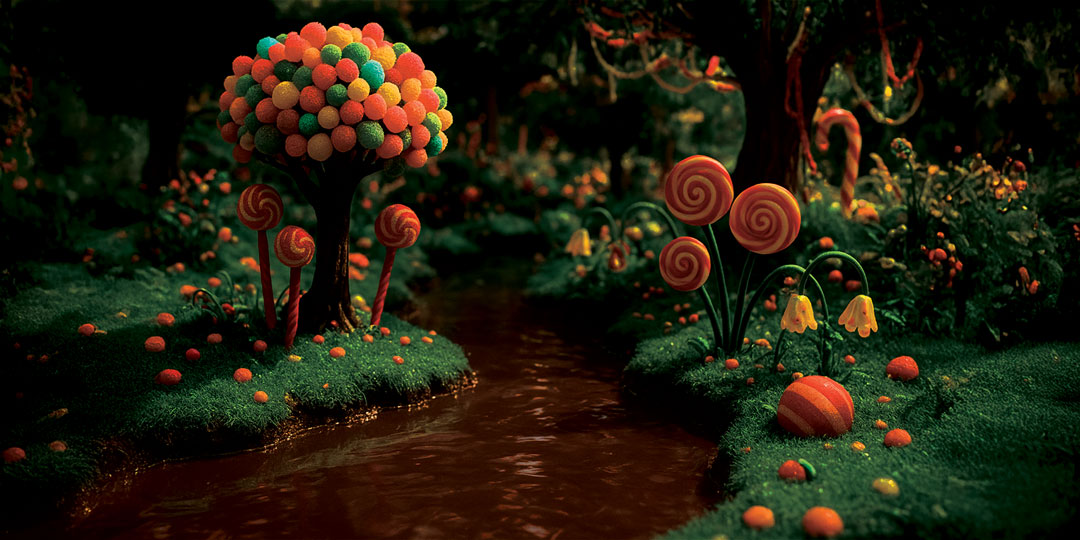
Roald Dahl’s Charlie and the Chocolate Factory is a story of wonder and a moral cautionary tale, which makes it a good premise for cinematic adaptation. There are two major films that bring this story to life—Willy Wonka and the Chocolate Factory (1971) and Charlie and the Chocolate Factory (2005)—which could not be more different in tone, style, and cultural legacy.
Gene Wilder vs Johnny Depp
The character of Wonka himself is the most notable difference from the two films. Gene Wilder’s portrayal of Wonka is a combination of charm, wit, and menace. He is eccentric and enigmatic, never showing what he is planning. His iconic entrance, where he stumbles forward, rolling into a somersault, captures his unpredictability and showmanship. From this small act, it was established that no one would know if he was lying or telling the truth.
Johnny Depp’s Wonka, by contrast, is just socially awkward. His behaviour is not have the gravitas like Wilder’s Wonka but rather a product of childhood trauma stemming from his dentist father. He shows a visible disdain for the children and their parents, often making direct insults. Depp’s general look from the pale skin to his bob is unsettling.
Dream vs Nightmare
The tones of the films are just as different. Stuart’s version is generally lighthearted with songs like “Pure Imagination” and “The Candy Man.” The interior of the factory, with the candy garden and chocolate river, is vibrant, colourful, and truly looks like an edible candy land, reinforcing a sense of imagination.
In contrast, Burton’s version is darker, with a cold and gloomy factory that feels almost prison-like. The candy land appears artificial, built merely for show. While Stuart’s world invited viewers to imagine they could actually eat the landscape, Burton’s world looked like a surreal nightmare than a whimsical candy factory.
Charlie as a Character
Charlie Bucket’s personality differs between the films. Stuart’s Charlie (Peter Ostrum) is not entirely perfect, as he has a brief moment of misbehaviour by tasting the fizzy lifting drinks with Grandpa Joe. This momentary lapse in judgement makes his choice to return the Everlasting Gobstopper an act of integrity.
Burton’s Charlie (Freddie Highmore) is consistently virtuous, which contrasts with the flaws of the other children. Charlie never misbehaves in the factory, and that earns him the reward. He initially turns down the offer to inherit the factory because he is unwilling to leave his family behind, and such an act further emphasizes his strong moral compass and the importance of family.
Faithfulness to the Source Material
Burton’s film is more accurate to Dahl’s novel. It includes details absent from Stuart’s version, such as the nut sorting room. It also directly uses some of the Oompa-Loompa song lyrics from the source material.
Cultural Impact
Surprisingly, Willy Wonka and the Chocolate Factory was not a box office hit upon release, only earning $4 million on a $3 million budget. However, it grew into a beloved classic through decades of television broadcasts. Charlie and the Chocolate Factory, however, had strong box office numbers, earning $475.8 million on a $150 million budget, but has not attained the same nostalgia as the 1971 version, po